
Elizabeth Fedde, pioneer Lutheran deaconess in America, died 25 Feb 1921.
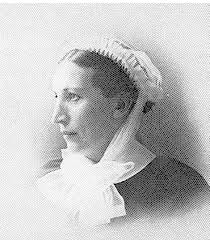
Elizabeth Fedde was born on 25 December 1850 near Flekkefjord, Norway. She was trained as a deaconess at the Lovisenberg Deaconess House under the supervision of Mother Katinka Guldberg, who had herself been trained at the Fliedner Motherhouse in Kaiserswerth, Germany. Elizabeth spent much of her early career in Troms, where she lived and worked under harsh and primitive conditions.
On her thirty-second birthday, Sister Elizabeth received a letter from her brother-in-law Gabriel Fedde challenging her to set up a ministry in New York City for Norwegian seamen there. She departed for the United States three months later and finally arrived on 9 April 1883. Sister Elizabeth firmly established her work beginning on 19 April the same year with the founding of the Norwegian Relief Society. (Ormonde Plater Calendar of Deacon Saints, 2015)
“Elizabeth Fedde – who?” I hear you asking. But Elizabeth’s fortitude in the face of adversity and her work as a pioneer deaconess justifies her inclusion in the calendar of saints, for which the only criteria are that you are ‘a dead deacon, of good reputation, full of the Spirit and of wisdom’ (Ormond Plater).
Certainly courage and perseverance are qualities which seafarers today require, if they are to survive months of isolation out at sea. And the tireless work of seafarers is often forgotten and undervalued. In a recent programme for the BBC, ethnographic researcher Helen Sampson speaks about her experiences at sea.
Thinking Allowed – Sea Travelling – BBC Sounds
Her research, drawn from months on board with the seafarers, draws three main conclusions for improving crew welfare:
- Reducing length of contracts
- Improving comfort of cabin, especially the bed
- Improving recreational space and facilities onboard.
See further Helen Sampson, Sea-Time: An Ethnographic Adventure (Routledge Advances in Ethnography) Routledge, 2024.
The Mission to Seafarers Today, I’m on a ship visit with Mahdi, who is kitted out with a new pair of safety boots and high-vis jacket. We’ve travelled from the Flying Angel Centre outside Rotterdam some distance to our first port of call. The Flying Angel symbol is well known to seafarers and it identifies us as part of the Mission to Seafarers, a ministry of the worldwide Anglican family of churches. The flag shows an angel in flight, carrying a book of the Christian Gospels, as described in the Book of Revelation.
I saw an angel flying in midheaven, with an eternal gospel to proclaim to those who dwell on earth, to every nation and tribe and tongue and people. (Revelation 14:6)
After presenting our ID cards, we pass through security and find ourselves port side of the Sloman Herakles. The sheer size of this port and difficulty of access may partly explain why seafarers are so invisible and easily forgotten these days. In the early years of the Missions, at the end of the 19th century, the port was much smaller, a boat enabled the Chaplains and Readers to move easily around the harbour from vessel to vessel, and also gave the opportunity of visiting ships lying at anchor and those waiting for the wind.
Deacons are sent as ambassadors to shine the light of Christ in places which risk being plunged into darkness. The sheer scale of today’s port makes the calling to ‘reach into the forgotten corners of the world, that the love of God may be made visible’ even more important. As seafarers are often “out of sight, out of mind”, it is the role of the port chaplain to go into those invisible corners of the world, to thank seafarers for what they do, and to remind them that they are loved by God, to know that they are not alone or forgotten.
Today, as so often, I’m moved by the warm welcome as we enter the messroom. There is a lively atmosphere as crew members greet us with ‘Chop-chop – would you like some food?’ This is the spirit of the camaraderie that they will need to keep them going on the darker days of their 6 or 7 months out at sea. ‘We’re like a family’, one seafarer from the Philippines tells me. And course that’s exactly what Jesus Christ called the church to be – one big family. On other visits, seafarers only have time for a quick word or two as they go about their various tasks. The reference to the ancient Greek hero Herakles seems well chosen, as the seafarer’s tasks are many and herculean!
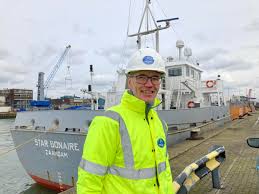
Jonathan Halliwell
Afterwards, I asked my colleague, Mahdi Pakzad, who has a first-hand experience as a Second Engineer, about the challenges faced by seafarers today:
Jonathan: What are the factors which are most likely to lead to depression and anxiety among seafarers?
Mahdi: I would say uncaring company culture, workplace violence, low job satisfaction, personal problems.
J: Are there any other factors which might lead to feelings of isolation and declining well-being?
M: There is the isolation from your family, sleep problems, the length of contract (seafarers can be away from home for more than 6 months) and the demand from your supervisor. Psychological research indicates that good relationships give a sense of meaning and improve well-being.
The International Seafarers’ Welfare & Assistance Network (ISWAN) is a charitable organisation which supports seafarers and their families around the world with their free helpline services, educational resources, relief funds and humanitarian support. Marine Benefits AS – International Seafarers’ Welfare & Assistance Network
J: Yes. As a Christian, it’s no surprise to hear that good relationships enhance wellbeing, since the Bible shows that God created humans for relationship. Christians believe that God came to live on earth in the person of Jesus Christ because he wanted to be with human persons. It is no surprise to hear that wellbeing depends on healthy relationships. But how does that work in practice?
How does the captain model good leadership? On one visit to the crew mess room, I did not realise that I was speaking to the captain, as he was dressed in plain clothes. He told me that everyone on board is part of a team, they depend on each other, and no job is more important than another. How important is it that the Captain builds good relationships on board?
M: If anyone in the management team (captain, chief engineer, chief mate, and second engineer (key officers) doesn’t behave with justice among other personnel, it causes isolation and a lack of transparency between the crew. As a result, a sense of trust is reduced, and the elements for meaningful relationships disappear.
J: Of course. I have met Ukraine seafarers who have to work alongside those from Russia. What challenges are presented by the different cultures on board?
M: I believe that most seafarers have a good understanding of politics and the difficulties between people in power. However, I can’t say such issues do not affect seafarers’ relationships with each other. The more important point about how different cultures get along is their interest in, for example, food, the way they make relationships with each other, the way they support each other, how they talk to each other; and the most prominent one is communication in their mother language. Even the way they deal with problems differs; for example, Filipinos generally have a more positive approach to issues than other nationalities.
J: Yes, that’s seems to be the case. In my experience, Filipinos tend to be the most upbeat and resilient, even when faced with some of the most menial tasks. Their Roman Catholic upbringing seems to offer them a deep faith and a sense of purpose. They are always happy to be prayed for, which also gives greater meaning to my work. I praise the Lord for their example of faith!
How can Christians show solidarity for seafarers?
Sea Sunday is an opportunity for us to remember and say prayers for all the brave men and women who work at sea to make sure we have all that we need. Join us to celebrate Sea Sunday and raise funds which help to provide essential support and services for seafarers who often work in dangerous and lonely conditions.
The Mission to Seafarers | Working In Over 200 Ports Worldwide Sea Sunday, 13 July 2025
Article by Rev Deacon Dr Jonathan Halliwell, education adviser to the Church of England Network of Distinctive Deacons, deacon in The Hague and a Mission to Seafarers chaplain.

 CofE Network of Distinctive Deacons