
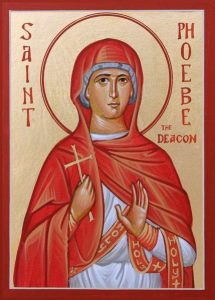
(Icon of Phoebe by Brian Matthew Whirledge, Antiochian Orthodox Christian Archdiocese of North America / WikiCommons)
Today we give thanks for our deacon sister Phoebe, who was Paul’s ‘sister’ too. He speaks of her at the end of his letter to the Romans: “I commend to you our sister Phoebe, a deacon [διάκονον] of the church at Cenchreae, so that you may welcome her in the Lord as is fitting for the saints, and help her in whatever she may require from you, for she has been a benefactor of many and of myself as well”. (NRSV Romans 16:1-2)
Cenchreae was the eastern seaport of the city of Corinth and a popular stop for people travelling from Syria or Asia Minor. A prominent member of the church at Cenchreae, Phoebe was Paul’s ambassador or minister plenipotentiary, bringing his letter to the church at Rome.
Four centuries later, John Chrysostom praised Phoebe’s work for the church as an inspiration and model for both men and women to imitate. He called her a saint—a holy person and a woman who served the church through the office of deacon.
Today Phoebe is honored as the prototype for women deacons just as Stephen is the prototype for men deacons. The name Phoebe means “bright” or “radiant”; Apollo and Diana, gods of the sun and moon, were often referred to as “Phoebos” and “Phoebe.” The Orthodox church in Cenchreae (now the small village of Κεχριές) is named after St. Phoebe the Deacon.
Paula Gooder called her first work of fiction ‘Phoebe: a story’, (https://www.gooder.me.uk/books/phoebe-a-story/) which gives a vivid view of what a first-century church in Rome may have been like, and how Phoebe would have fitted in.
Today, Phoebe continues to inspire the church, and especially those women in the Roman Catholic and Orthodox Churches who work tirelessly for the inclusion of women in the diaconate.
Click to access deaconsaints_plater.pdf

 CofE Network of Distinctive Deacons