
Deacon of the month – Philip
‘Deacons are to work with their fellow members in searching out the poor and weak, the sick and lonely and those who are oppressed and powerless, reaching into the forgotten corners of the world, that the love of God may be made visible.’– Ordination of Deacons
Philip the Deacon was one of the seven chosen to assist the apostles. All we know of Philip is what we are told in Acts 6:5, 8:4-40, and 21:7-9. He was the first to preach in Samaria, where he converted Simon Magus. Later, on the road from Jerusalem to Gaza, he instructed and baptized a eunuch who was chief treasurer of the Queen of Ethiopia. He was so successful in his preaching that he was surnamed “the Evangelist,” which has sometimes caused him to be confused with Philip the Apostle. His feast day is observed on 11 October in Orthodox and Episcopal churches. (Extract from Ormonde Plater, Deacon Saints)
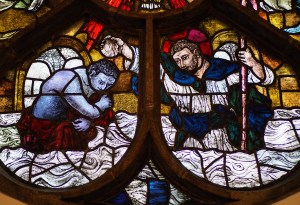
Our deacon of the month is the subject of the baptismal stained glass window in the Anglican church of St John & St Philip, the Hague, where is shown baptizing the eunuch. According to Michael Banner, ‘the scene gained some popularity in the Protestant Netherlands in the mid-sixteenth to early seventeenth centuries, as part of a turn away from saints and their legends in favour of biblical characters and incidents’. Water on a Desert Road | VCS (thevcs.org)
The Book of Acts does not have a central place in many lectionaries and the story of Philip’s baptism of the Ethiopian eunuch is not as well known as stories such as Peter being loosed from the chains which bound him in prison. But it is memorable and highly significant for the mission of the Church. In this fast moving account of the early church, Philip is a deacon ‘on the move’, prompted by an angel to get up and go on the road from Jerusalem to Gaza (Acts 8:26).
Luke (the writer of Acts) uses the word eunuch five times in this story and clearly wants to draw attention to this marginalised figure. Luke tells us that that the eunuch was returning home from worship in Jerusalem in his chariot; when Philip encounters him, he was reading Isaiah, that great prophet of hope, which specifically names eunuchs, foreigners, and the outcast of Israel as those whom God will gather joyfully to his holy mountain and his house of prayer (Isaiah 56). Perhaps he had found particular consolation in the words, ‘My house shall be called a house of prayer for all peoples.’ (56:7) As Simon Woodman remarks, this Ethiopian eunuch is longing to belong with God’s people and to be part of the household of God.[1]
We are told that the Spirit prompted Philip to go over to the chariot, where he finds the eunuch reading a passage from the Book of Isaiah 53:7-8 (in the Greek translation, the Septuagint) about the suffering servant:
“He was led like a sheep to the slaughter,
and as a lamb before its shearer is silent,
so he did not open his mouth.
In his humiliation he was deprived of justice.
Who can speak of his descendants?
For his life was taken from the earth.” (vv.32-33)
Unsure how to understand this, the eunuch asks ‘does the prophet say this, about himself or about someone else?’ This is all Philip needs to speak – and starting with this scripture, to proclaim to him the good news of Jesus. (v.35). Luke’s choice of phrase, ‘opening his mouth’ (ESV) is interesting here, as it echoes the previous description of the suffering servant who ‘did not open his mouth’. It is well know that Jesus’ humiliating death came to be interpreted through the figure of the suffering servant. But as Diarmaid McCulloch notes in his book Silence: A Christian History, the only unusual feature about the Servant’s behaviour is his silence (Isaiah 53.7). I suggest that this motif of silence is significant here because it is by breaking through the silence of the eunuch’s exclusion from the Temple, that Philip opens the way for the eunuch to join the household of God.
It is likely that this man had been drawn as a god-fearer to Judaism, though his ethnicity would have marked him as a potential outsider in the temple of Jerusalem. Despite his exalted position in the Queen of Ethiopia’s entourage, he was prohibited from worshipping in the part of the temple where men worshipped (Deuteronomy 23:1-2). He would have had to stay in the open temple court with the gentiles and the women, rather than entering the heart of the temple complex with the other men. It is this barrier to full membership in God’s people which lies behind his question “What is to prevent my being baptized?”
The figure of the suffering servant resonates here in a specific way: the eunuch had suffered physical abuse and ‘in his humiliation justice was denied him’. And now he stands before Philip, a living witness to the scandal of exclusion. As Philip opens his mouth, interpreting the Christ event through the figure of the suffering servant, he brings fresh insight and understanding to the eunuch. The empowering Spirit of God breathing through the Scriptures, as it were, “opens the mouth of the silent lamb”, and enables the eunuch to identify his own suffering with that of Christ. And in doing so, he opens the path to resurrection life.
Survivors of abuse
The figure of the suffering servant who was silenced, humiliated and denied justice is a fitting subject for the Anglican church of the Hague, situated as it is near the International Court of Justice of the United Nations.[2] Home as well to the International Criminal Court, the Hague is known internationally as a city of peace and justice; it strives to uphold the dignity and rights of all people, not least the oppressed and powerless.
One way in which this story might continue to resonate today in the Church is with regard to victims of abuse, who are often silenced by the perpetrator and continue to remain in silence. As the church, we owe it to survivors to do whatever we can to support them in finding and using their voice. The sense of empowerment in being heard by others has a critical part to play in the recovery and healing process. The Diocese of Newcastle has developed a chaplaincy for survivors and adopted a strategy called “If I told you, what would you do?” It includes the question ‘Would you encourage me to use my voice?’[3] Lead officer, Maggi Creese, told me that it is important to make our offer of support to survivors invitational and to make it an offer to stand alongside them in solidarity as they do the work of finding and using their voices.
As John Vilaseca and Rae Caro write, “Our voice is one of the most powerful gifts we have. God listens to the voice of those who are crying for help and support. God listens to our voice when we need to be heard. As the church, we ought to reflect God’s attentive listening towards those whose voices have been silenced. We need to encourage people to find their own voice to speak and share their story without pressure or expectations, but with the certainty that their voices will be heard and never silenced.”[4] One of the best ways that individuals and communities can be enabled to respond well is through creative projects that create a space for conversation between those with lived experience and others in their communities.[5]
Perhaps there is an opportunity here for distinctive deacons?
Jonathan Halliwell
Home – Safe Spaces England and Wales
Survivor engagement | The Church of England
[1] See Simon Woodman’s sermon Baptist Bookworm: Philip and the Ethiopian Eunuch
[2] Homepage | Peace Palace (vredespaleis.nl)
[3] If I Told You, What Would You Do? – Newcastle Diocese (anglican.org)
[4] Would You Encourage Me to Use My Voice? – Newcastle Diocese (anglican.org)
[5] Sparrows Creative Project – Newcastle Diocese (anglican.org)

 CofE Network of Distinctive Deacons