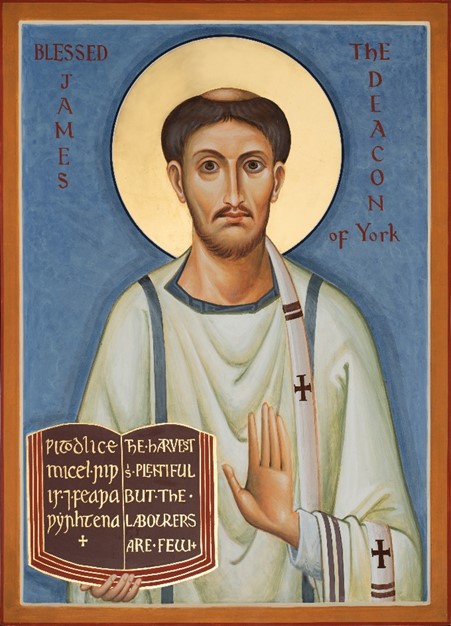
According to Deacon Ormond Plater (see his calendar of deacon saints https://www.episcopaldeacons.org/uploads/2/6/7/3/26739998/deaconsaints_plater.pdf ), James the Deacon is celebrated on 17 August. He was “a man of great energy and repute in Christ’s church” (Bede), remaining in the north of England when Paulinus, the priest who had been charged with taking the faith there, fled under the persecution of Penda. He also taught and practised Gregorian chant, which would have been new to the Anglo-Saxons. Maybe some of our music still has the power to bring people closer to Christ.
James the Deacon: his Life and Legacy
Life
In 597AD the marriage of the Jutish King Ethelbert to Bertha, the Christian daughter of the King of Paris, made it possible for the faith to be re-established in Kent by a band of Benedictine monks led by St. Augustine (who became the first Archbishop of Canterbury). They had been charged by Pope St Gregory the Great with the task of converting the Anglo-Saxons.
Paulinus was one of the monks sent to Kent by Pope Gregory in 601AD to support the mission of Augustine to the Anglo-Saxons. It is believed that James the Deacon was a companion of Paulinus. The details of the birth and death of James the Deacon are not known, though, since he accompanied Paulinus, he may well have been Italian. James seems to have been very active in assisting Paulinus on his mission in southern Northumbria.
We know precious little about him other than in his connection with the Gregorian Mission, a part of which, the mission to York, was led by St Paulinus, and is recounted by The Venerable Bede (673 to 735AD) in his famous Ecclesiastical History.
Bede describes Paulinus as “a man tall of stature, a little stooping, with black hair and a thin face, a hooked and thin nose, his aspect both venerable and awe-inspiring”. It is probable that Bede obtained this description of Paulinus from James the Deacon, who was said to be still alive in Bede’s time.
In 633 Edwin, King of Northumbria, a recent Christian convert, died in battle. When he received this news Paulinus, the Bishop of York who was instrumental in Edwin’s conversion and influential in the spread of Roman Christianity throughout Northumbria, abandoned his Northumbrian base and retreated to Kent as part of the court of Edwin’s widow and son. This action was in line with the prevailing Roman attitude of serving under, and with the blessing of an established authority. Paulinus left James, a solitary deacon, as the only representative of the Roman Church’s mission to Northumbria.
James remained in Northumbria, living mainly at a village near Catterick (now in North Yorkshire) and took an active part in the preaching of the gospel and baptising throughout the region. James represented Christianity in the face of hostility from Penda of Mercia, ensuring the survival of Roman Christianity in the region. Preaching the gospel under a pagan ruler was a risky occupation, and James was often in danger of his own life. It is largely due to the efforts of James and his associates that when the Northumbrian mission arrived in the area approximately five to ten years later there was still evidence of active Christianity to be found.
In more peaceful. times, after the death of Penda and the re-establishment of Christian rule, James taught music, especially Gregorian Chant, to the emergent churches of the region, and is praised by Bede as being a man of honour and integrity. As an old man, he attended the Synod of Whitby in 664, which met to discuss the differences between the Celtic Northumbrian Church of the north and the Roman Church of the south. James stood for Roman Christianity in an area which was far more sympathetic to the Celtic form of the Faith.
Although the date of James the Deacon’s death is uncertain (possibly around 668AD), he lived to a ripe age, as Bede records; ‘At last, being old, and ‘full of days’, as the Scripture says, he went the way of his fathers.’
Though not a monk and therefore without a community to perpetuate his memory, he seems to have had enough popularity that life was commemorated by the ordinary Christians, both Celtic and Roman, that he had served in the days after the flight of Paulinus. His Feast day is 11 October, the day after that of Paulinus.
Legacy
In his account of the times, the historian Frank Stenton has called James “the one heroic figure in the Roman mission”. This reflects the fact that many of the Gregorian missionaries had a habit of fleeing when things went wrong whereas James remained steadfast. While others who came across on the mission from Italy became Bishops, James remained a humble Deacon, who through his tireless labours, built up the Church in the North.
Gill has been a missioner in Nigeria, Romania and various parishes in England. She was ordained a 'distinctive' deacon in 1991. In this capacity she was warden of the College of St Philip the Deacon in Exeter diocese, and founder member of the CofE Network of Distinctive Deacons https://cofedeacons.org. She has also written the story of her own call, Deacon by Design. https://www.waterstones.com/book/deacon-by-design/gill-kimber/9781910719794
She's passionate about the diaconate and, now retired, continues to support those who are called to this ministry.
View all posts by GillK



 CofE Network of Distinctive Deacons