
Thanks to Jonathan Halliwell for this report on our recent conference . . .
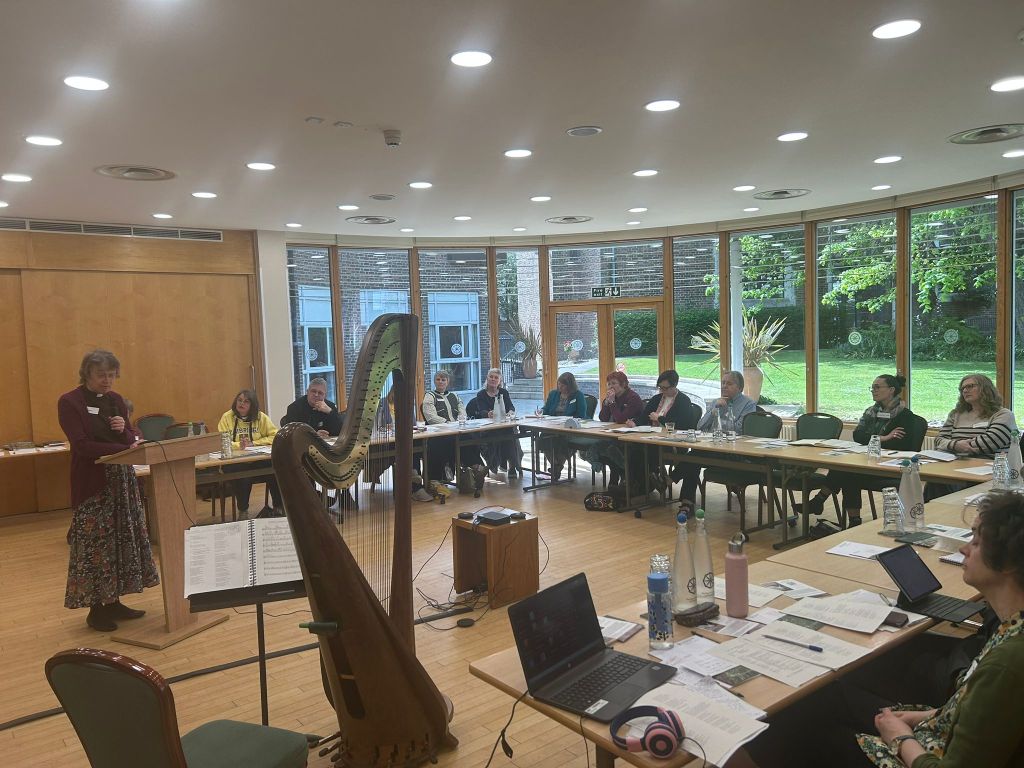
A conference retreat organised by the Church of England National Network of Distinctive Deacons held at the Royal Foundation of St. Katherine on Saturday April 25th brought together 26 in person with 30 on line to share and discuss the calling to the distinctive diaconate, which is both distinctive and rich in all its diversity.
“An effective deacon will kick up the dust!” was how + Pete Wilcox, episcopal champion for distinctive deacons, summed up the vocation to the diaconate, tracing the word diakonos (one possible meaning ‘through the dust’) through the gospel of Mark, a fitting subject for the feast day of St Mark (25 April).
Servant-heartedness has always been a part of the DNA of deacons, but recent scholarship has changed the focus of a deacon from menial service to that of a commissioned agent serving as a herald of Christ’s kingdom. This is a Christ-like, cruciform calling. As + Pete reminded listeners, the way of the cross “is for anyone who wants to be an authentic follower of Jesus”. Jesus was a Deacon with a capital ‘D’, a model deacon. For the Son of Man “came not to be served, but to serve, chiefly by giving his life as a ransom for many” (Mark 10:45).
Distinctive deacons today are women and men set apart by ordination to proclaim, live out and enable others to follow the way of the cross. In the words of the Ordinal (CW), deacons “are to work with their fellow members in searching out the poor and the weak, the sick and lonely and those who are oppressed and powerless, reaching into the forgotten corners of the world, that the love of God may be made visible.” Christ is the pattern of their calling and their commission.
The conference speaker, Canon Rosalind Brown is the author of Being a Deacon Today, a key manual for those in discernment for ordained ministry. Rosalind’s interest in spiritual formation emerges in the introduction to her book: ‘the diaconal vocation is always a blend of being and doing. To define a deacon solely by function runs the risk of reducing the church to one more human agency among others.’ In the conference, she addressed the theme of ‘Praying with Hope on the Margins – Deacons Interceding for a Wounded World’. Her choice of title was prompted by her observation that The Lord’s Prayer does not include a petition for those on the edge of society, though it is perhaps implied by the words ‘Thy Kingdom Come’. Rosalind’s reflection on Psalm 137 as a prayer from the margins was supplemented by her own original hymns, sung by to the accompaniment of a harp by an ordinand Lucy Bunce. This helped to set the scene for the writing of contemporary psalms by participants working in small groups, a practice which could easily be shared with churches.
The Preface to the Ordinal states that, ‘from the Apostles’ time there have been these Orders of Ministers in Christ’s Church: Bishops, Priests, and Deacons’. The ecumenical contributions from Roman Catholic and Methodist speakers strengthened the conviction that a fully-fledged Anglican church demands the revival of the foundational order of the diaconate.
As the Church of England finds itself in a precarious position with dwindling numbers of vocations to the priesthood, there is a need to mobilise vocations generally. This movement of tectonic plates is an opportunity for Distinctive deacons, who need to be part of this conversation and involved in vocations teams across the country.
In the final session, four Distinctive Deacons revealed the diversity of this ministry in everyday settings, which underlined the breadth as well as depth of this Christlike calling for deacons, and ultimately, for all the baptised.
May we, being firmly grounded in the truth of the gospel, be faithful to its teaching both in word and deed (from the Collect of St Mark)

 CofE Network of Distinctive Deacons